Research Art Lab

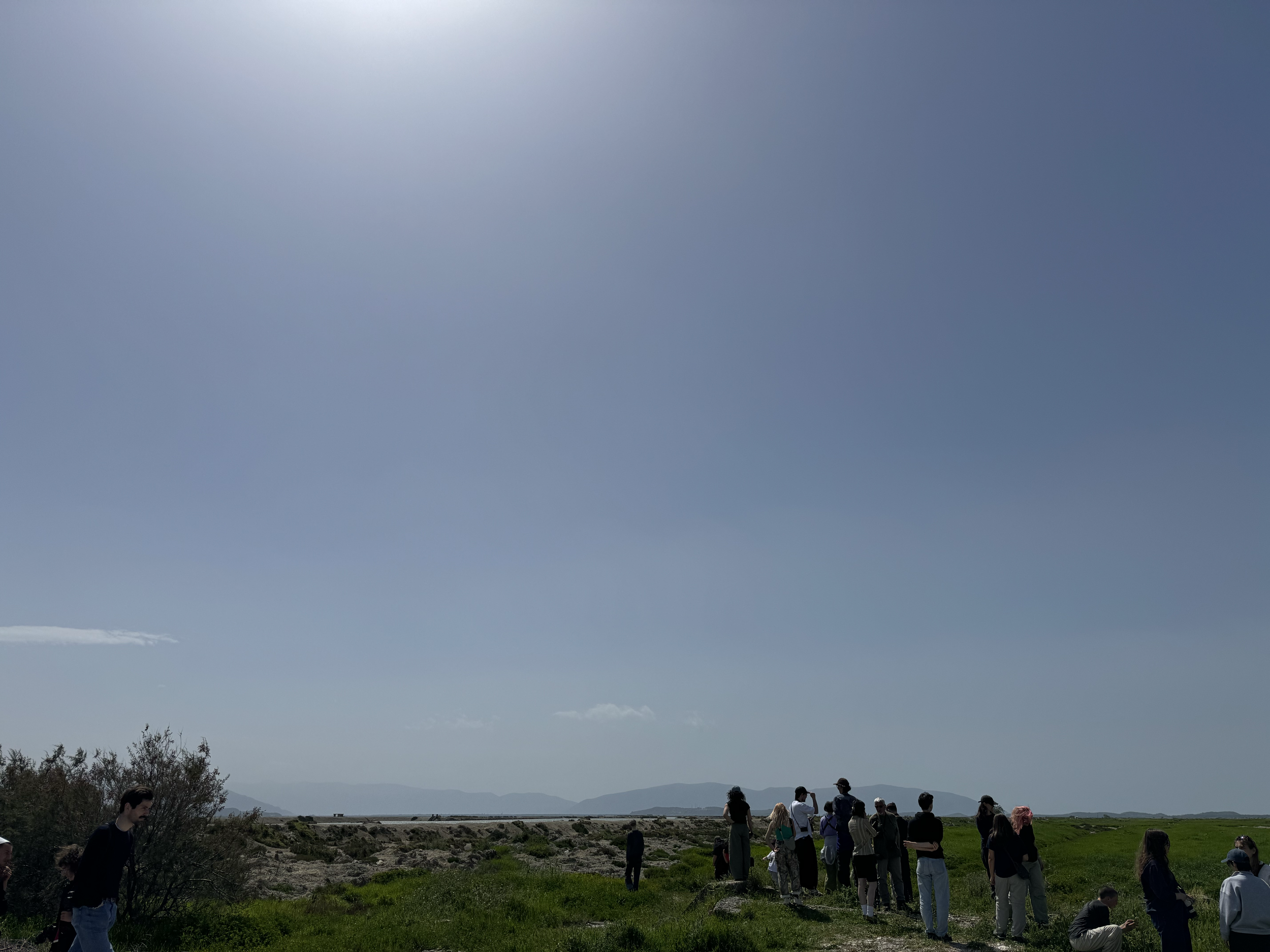
Research Art Lab is inspired by the creative spirit of invention that took place on Orford Ness in the twentieth century. Throughout the 2025 season, eleven artists are using the Power House building as a temporary studio laboratory to experiment and test new ways of working based on active research around Orford Ness and engaging with its shifting ecology and heritage.

The Research Art Lab programme activates the Power House into a live working creative space, making public the process of developing and testing work that often takes place behind closed doors. Here visitors can see the process of creative research and experimentation as it happens rather than as a finished outcome.

Each of the Research Art Laboratory artists draws on the legacy of the Ness, its Research Laboratories, and as a site for experimentation and improvisation. Instead of experiments into defence and destructive forces, the Research Art Lab artists will prompt new ways for us to look at, question and understand the heritage, shifting landscape and ecology around us. 

  • During the First World War research and trials took place on Orford Ness to find effective camouflage colour palettes and patterns on day and night flying machines, including painted aeroplane body work and wings. Experiments were largely based on observation, trial and error in relation to the landscape and viewpoints from above and below. Jane spent three weeks painting in this strange landscape, observing and recording a contemporary seasonal colour palette of the vegetated shingle and marshland found below the horizon line.

    This body of work draws on Jane’s firsthand physical and visual experience of the landscape. It is made in and of the site. She worked quickly observing and mixing a series of colours that she then used to create small and largescale paintings. The works developed instinctively with intuitive, quick mark-making made by brush on saturated canvas and paper. Her first works Below the Horizon and Research Art Lab Camouflage Colour Palette, Orford Ness used watercolour and this watery way of working informed the later larger scale acrylic on paper and raw unstretched canvas: Wingspan. She then returned the work into the landscape to photograph it within this vast desert-like space. WIngspan was animated by the wind and dwarfed by the environment which it references and in which it was made.

  • Sara conducted a series of experiments that responded to the lines, grids and tracks that appear everywhere on Orford Ness. She was intrigued by the throwing out and dragging back of the Manby Mortar lines used by The Coast Guard Lookout, the vegetated shingle lines sculpted over thousands of years, and the MOD surveillance plotting methods to record bomb flight paths.

    Using chance and autonomous tracing as part of the process, I harnessed the wind and light to draw, make pin hole photographs, and ‘map’ original north/ south & west/ east bomb ballistic trajectory paths and their points of impact.

  • My attention has been caught by a number of ideas I want to explore during this Research Art Lab residency on Orford Ness.  One of these is around NIVO, abbreviated from Night Invisible Varnish Orfordness. This overall paint finish was applied to British night bomber aircraft in the inter-war period (1918–1939). Developed in 1918 by the experimental station at Orford Ness as a low-visibility colouring for the Royal Air Force, it had a sheen to match that of ‘open water on a moonlit night’. I am intrigued by such a poetic origin employed towards military utility.

    This has also led to an interest in early aviation activity and the skies above Orford Ness. My focus currently lies, in particular, with the omnipresent line of the horizon. It becomes a reference point, but one of shifting scale, rife with illusion and inaccuracy, often resulting in misjudgement of location and distance. These errors are those of idiosyncratic sight, invisibility that lurks within a ubiquitous visibility.

    Using camera lucida drawings and NIVO painted objects, and employing homemade camera rigs with which to record the horizon, I plan to spend my residency testing out the parameters of a kind of ‘skewed visible’.

  • My plan for the Research Art Lab is to develop a series of experimental works on paper and fabric, using photographic studies, rubbings and drawings of the surrounding landscape as a starting point. I aim to integrate selected sources derived from my current practice within this, to create a visual dialogue with the context of the site, its history and the work generated there and beyond. One of these sources is a small group of painted wooden birds made by artisans from Hyderabad, India – which I intend to photograph using the accessible areas of the site as a backdrop. I am interested in how this activity might be ‘read’ in relation to observing the existing migratory patterns of birds at Orford Ness; and the potential for this to be developed as a visual metaphor for my concerns around cultural hybridity. As an additional layer to this, I would like to integrate my current interests in lightness, shimmer, colour and repetition. Specifically, to explore the potential overlap between the stylistic qualities of shell suits and the patterns used in the visual aesthetics of disruptive camouflage.

  • Clouds is a record of rapidly changing clouds drawn from observation inside the Orford Ness Power House. The drawings were inspired by scientific visualizations of global climate models of the atmosphere and historic nuclear ballistics tests at Orford Ness. They were created with a systematic approach using the orientation of the Power House windows precisely facing the cardinal directions. Each diptych captures an observation in each of the four cardinal directions a single day. The sketches are a meditation on fluid dynamics, considering military human endeavors in relation to exponentially more powerful natural clouds.


  • During my time at the Research Art Lab, I am interested in exploring the flora of Orford Ness, in a series of works exploring floriography - the language of flowers, which was popularised in the 19th century, and in Victorian England in particular. I am intrigued in how this coded form of communication might relate to the history of codes and official secrets surrounding the site at Orford Ness as a military testing site. I aim to make a series of collages incorporating pressed flowers, and photographs using 35mm colour film. Building upon the well-known Victorian vernacular, I hope to add new flowers and new meanings in order to build my own personal lexicon of floriography that is specific to Orford Ness.

  • Whilst here, I am considering the word ‘exposure’ and also a second word, ‘focus’. I am proposing to be on The Ness each month, over the course of one year, to determine the changes and constants that I note in relation to these two words and to see what emerges from this. 

    Keeping to the prescribed routes on the Ness is beginning to yield unexpected visual opportunities. My behaviour as an artist here feels more akin to that of a naturalist - waiting, looking, spotting, tracking, retracing steps and staking out vantage points. Being patient, slow thought and small advances becoming allied. 

     The Ness has been described to me as ‘curated decay’ and for this reason I have set myself a rule of not picking anything up. This goes against my nature as an artist and requires all my will power. 

    Endurance, as a quality, feels aligned to the particular hazards and potentials that this extreme environment brings to all living things. The fact that living things are set apart by their differences and adapt to function alongside one another embodies an ethical tension where humans are concerned and especially in light of the workforce, six hundred plus, that once occupied The Ness.

    The MOD first utilised this isolated location and its natural resources in 1913 with far less concern, perhaps, for the fragility of its mineral, liquid, plant and animal ecosystem. Exposure and focus appear to be vital forces here, physically and metaphorically, whether under or over, soft or sharp.

  • Orford Ness has many layers of history- some visible, some hidden. Arriving at the Power House it was hard to know where to start, so to ground myself I started drawing pebbles. Just a few, to help me focus and really look, and familiarise myself with Orford Ness' deep history. Some days I worked at the printing workshop of Suffolk University, to make risographs of the Hoary Ragwort, Yellow Horned Poppy and Red Valerian. Drawing and printing these plants had a surprising effect - I finally noticed the Red Valerians right outside my flat in London. Near all of these prints I gave away to visitors to the Power House, much to their surprise and delight, however, they did not realise they had already paid me with their time and attention.

  • RAL diary extract:

    I make camera tests, throwing the camera to record its own flight. Wandering around the pagodas and lab buildings I take some panoramic photos on my phone and some vertical panoramas that capture a vertical view of the landscape in a similar way to the thrown camera images where the horizon shift from horizontal to vertical giving a dizzying perspective, an un grounded one which destabilises the human centred view of the Ness.

    These experiments are mixed successes and failures, there is a chance element in the making of the image as it is dependent on a dance between me and the camera. It is the movement of my body which tricks the phone into making these images. There are many failed attempts. As I return on foot to the Power House I notice the stillness, the silence, hares, butterflies, bees, birds, flowers, the other aspect of this site, its flora and fauna.

  • Orford Ness was an extensive laboratory where I could investigate and reveal the past bycollecting olfactory and textural materials.

    Initially referencing Gabriel Orozco's work and noting the circles that appear across the Ness, I formed balls of clay and plasticine to capture surfaces, smells, and textures.

    I was particularly interested in the Armoury, which has a mysterious aroma that has lingered in the entrance for many years.

    The findings were translated into a series of monoprints, drawings, and a faint perfume emanating from a range of 3D forms.

    The writing of Caitlin de Silvey, Doreen Massey, Merleau Ponty and W G Sebald accompanied me on my investigation.

  • The residency was an opportunity to explore attentive live listening and how to invite others into the process through hand-held listening scores and other activations.

    Inside the powerhouse, I experimented with an audience-activated micro-listening of the Ness teasels built from plant materials andanalogue electronics.

    Outdoors, I listened to the site with my body as an ear, no tech. From this process came the listening scores, folded paper pamphlets which soon became sounding objects themselves as their materiality interacted with weather, landscape, and listener.

    Questions to take forward: What does this listening reveal and what work might emerge?